For my #HamRadio tunable elevated radial project, I want to isolate them from the earth and the mast, and I'm not finding an isolating mount that goes into a normal ½" "light stand". So I've come up with this design to build. (Yay, I can't just buy it, so I have an excuse to spend some shop time!)
From 1" 6061 aluminum stock and 1" POM:
An aluminum stem/spigot that fits the tripod, with a 1" section above. In that section, an M14x1.5 threaded socket.
A POM threaded bushing; M14x1.5 on the outside, M10x1.5 on the inside, with a 2mm flange on top
An aluminum piece on top with M10x1.5 screw threads on both end, and six 4mm holes drilled around it to accept 4mm banana/bullet plugs. The M10x1.5 is to match the JPC-12 feed base.
I intend to raise only two radials, but six holes give me a chance to change my mind later, and even with just two they make it easy to line up the holes well enough with where I want the radials to run. (An elevated radial is worth about 8 ground-coupled radials.)
My idea is to machine the POM threads a little over-size, so that the whole thing is hard to screw together and locks together kind of like a nylon locknut. The larger diameter of the aluminum pieces will be knurled to facilitate this. It's meant to be strong enough to hold as much as 30 feet / 10m of loaded vertical, including JPC-12 riser sections, JPC-12 loading coil, and up to 25' whip.
Have a small plane and want to get approval for a reasonable change that requires approval? It looks like the FAA doesn't want to be bothered with your innovation any more — only large companies need apply now. #aviation
The additional spectrum on the #HamRadio 60m band for US operators, and the reduced power limitation that applies to the current channel 3, is not yet effective. Don't start transmitting outside your station privileges because you heard about the FCC releasing an order.
IT IS FURTHER ORDERED that the amendments of parts 2, 25, 74, 78, 87, 90, and 101 of the Commission’s rules, as set forth in Appendix A, ARE ADOPTED, effective thirty (30) days after publication in the Federal Register.
I don’t see it in a search at https://www.federalregister.gov/ — but I’m not an experienced user of that site, so my search may have been wrong, and I would appreciate correction if I am.
I expect it to show up in the list of recently published documents by the FCC, after which we’ll know when it becomes effective. (I do not see it there as of the moment of writing this.)
Until it is effective, your transmissions at 100W on channel 3 are still legal. Once it's effective, those same transmissions will be limited to 15W EIRP (radiated power from a mythical antenna; the radio equivalent of a "spherical cow of point mass") expressed as the 2.15dB lower 9.15W ERP (dipole, an antenna that has the benefit of existing in practice).
If you use an antenna other than a dipole, please note:For the purpose of computing ERP, the transmitter PEP will be multiplied by the antenna gain relative to a half-wave dipole antenna. A half-wave dipole antenna will be presumed to have a gain of 1 (0 dBd). Licensees using other antennas must maintain in their station records either the antenna manufacturer's data on the antenna gain or calculations of the antenna gain.
#AmateurRadio
I made a #HamRadio antenna that I really like, and wanted to share the design and process so others can do it too. It's a carefully-tuned linked dipole that is light and has served me well for #POTA activations. It's now in its second iteration and so far I'm very happy with it.
I haven't seen many antennas that use bullet/banana plugs for links, and I haven't seen any that use heat shrink and cord to create unstressed link points that wrap nicely. Someone must have done it, but I haven't seen it yet. This avoids the mess of alligator clips, and it's so tidy that I can cover all the bands from 6m to 40m without any mess stowing or deploying it.
I use it for QRP, but it will support 100W "barefoot" because it's resonant.
I tuned mine for CW, but you can tune it for near the top of each band, and add little stubs to extend it down to lower parts of that band to work lower parts of the phone space or all the way down to CW.
I've added options for different (or no) choke and different connectors.
https://forum.makerforums.info/t/a-compact-ham-radio-linked-dipole-antenna-with-3d-printed-parts/94519?u=mcdanlj
The end of an era.
About 15 years ago, I got a used 42U rack, and with great effort got it into my basement, where it held various computers and UPS units over the years. A couple years ago, though, I moved to a smaller computer as the "home server" and emptied out the rack. The rack then sat empty in my house, a bulky relic.
This evening, an acquaintance came and picked it up, so it's off to live a new useful life again.
And now a path through the basement is newly re-opened. 🎉
RE: https://mastodon.social/@joeycastillo/115679311941728952
"The burden of communication is on the speaker/writer" is something that I absorbed from a friend and have taught for years. I have felt the asymmetry in communications with LLMs as an intermediary but hadn't thought explicitly about how it undermines this social contract.
Earlier this year, I wrote something and asked for feedback. A co-worker gave it to ChatGPT and gave me what it spit out.
He didn't invest effort; didn't bother to take the time to tell me anything he didn't like about what I wrote.
Given that we have an enterprise license to ChatGPT at work, that was a passive-aggressive diss equivalent to sending someone a LMGTFY link
ChatGPT added subtle lies that took work on my part to identify and articulate
So the burden of communication about my communication was on the person giving feedback, and they completely failed the test and broke the social contract, and then were surprised that I was unhappy. How could I possibly object to having a confabulation machine rewrite what I wrote?
(I'm not an AI hater in general. But I can be dismayed by abusing people, including if it's done with an LLM.)
“LLM-generated prose undermines a social contract of sorts: absent LLMs, it is presumed that of the reader and the writer, it is the writer that has undertaken the greater intellectual exertion. For the reader, this is important: should they struggle with an idea, they can reasonably assume that the writer themselves understands it. If, however, prose is LLM-generated, this social contract becomes ripped up: a reader cannot assume that the writer understands their ideas.” https://rfd.shared.oxide.computer/rfd/0576
Over the past couple weeks, I've been designing a spool with some particular features in #FreeCAD, encompassing 6 parts to 3d-print. I've been manually re-orienting them when I print them.
Now that it's working, I realized that I could use the FreeCAD Assembly workbench to create a good packing of the parts in the right orientation for printing, saving anyone else who wants to print it the trouble of faffing about in the slicer. (I myself printed at least one part upside down from my design intent once, and I'm the designer!) The whole assembly can be exported as a single STEP file (or, I guess, single STL file), imported into the slicer as one thing containing multiple objects already arranged.
Since my design starts out with the parts "assembled" with relation to each other using simple parametric placement, and I'm pulling them apart to print, I guess this is a disassembly?
To do this, I needed to align the printing surfaces. But I wasn't sure how to create a "coplanar" constraint in the new, built-in Assembly workbench. A google search gave me a wrong AI-generated answer to use the Parallel Joint constraint; it seemed unlikely, but I tried it and thus confirmed that the AI was once again confabulating. The right answer was to use the Distance Joint, which when set to 0 between planes constrains then to be coplanar.
If someone changes the parameters in the model, they night have to slide the parts around in X and Y to make them fit, but even if they change the thicknesses, the parts should stay with their bases properly coplanar in Z so the whole thing can still be exported and printed as-is.
I think I'll make more use of this in future designs, in preference to written README.md instructions for how to orient pieces in the slicer.
I like how the built-in Assembly workbench has a relatively parsimonious set of constraints that are each fairly powerful and context-aware.
@qrper@mastodon.radio mentioned in his recent video how some hams like to make antennas.
Guilty as charged.
It was only last night that I finished my new linked dipole. But sometimes I want to operate with a vertical. Putting radials on the ground has worked pretty well on North Carolina Piedmont clay, but on dry sand near the beach, they acted like tuned radials, and the antenna performance was terrible, except on the 20m band they were cut for, because the dry sand wasn't conductive.
Now I want to be able to set up an elevated vertical with elevated radials, field-tunable for multiple bands.
My thought is to tune the vertical for SWR with the antenna on the ground, then move it up to an elevated base (I have a tripod for this) and elevate radials.
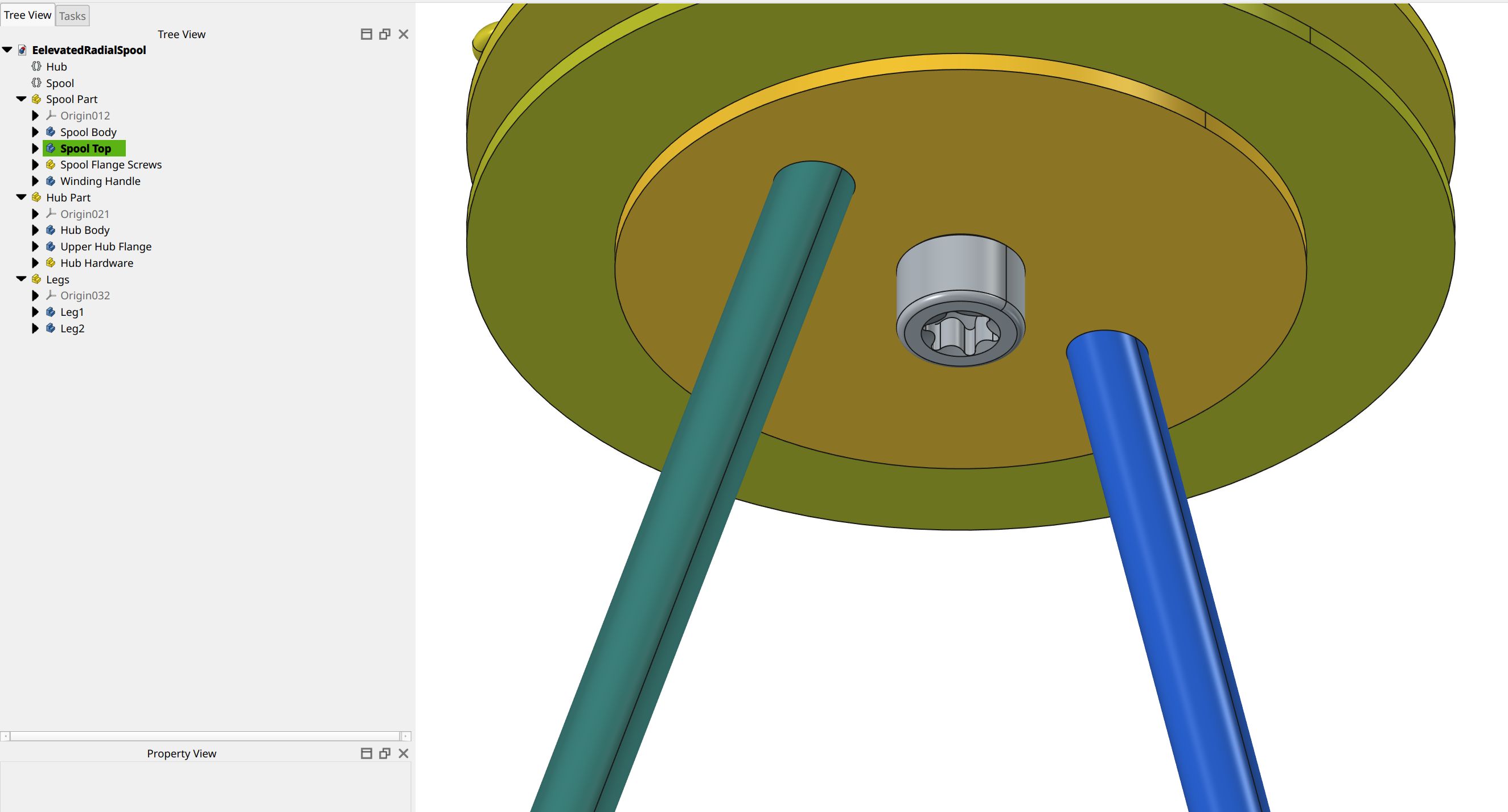
My current idea is a spool with knobs on top. Wrap wire around the spool and pay it out to the right length for the band, then loop it around one of the knobs to hold it in place. Two driveway markers underneath act as legs.
How are two legs stable? Tensegrity!
Make the whole contraption lean away from the antenna, and hang a little weight from underneath, with the radials in tension.
Five 3d-printed parts, fourteen screws, and two driveway markers per elevated radial. Heat-shrink printed labels marking the right spot on the wire for each band, or maybe even the top and bottom of large bands so that I can tune. Maybe other labels for if I move the vertical element up a lot higher and deploy radials down like a discone, in which case the radial lengths will have to be different. I could imagine just two of these for normal mostly horizontal deployment, but three or four for a portable discone.
I expect that would make for an efficient vertical antenna setup that will work over any ground and not require any stakes or other ground fixtures, just maybe a few weights on the tripod if it's windy, and some light weights (dual-purpose my arborist throw bags? borrow local rocks?) pulling out the radials.
#HamRadio #AmateurRadio

The prototype worked well enough that I'll proceed on to another iteration. Leaning it out with two legs held up by the radial wire worked well, and the little knobs on the top of the spool to hold the wire in place work fine. I'll made them a touch larger to be more robust, but the concept works.
I want to be able to fit 12m of wire on the spool, because I want radials that work well as flat radials on 40m, which might take up to 28%λ instead of the nominal ¼λ which would be appropriate in the "discone" setup with 45° radials. However, with this wire, 8m barely fits on this spool. So I need to add a generous allowance for more wire.
I need a handle for the hub at the bottom so that I can wind it up with the legs removed. It's unwieldy with two 6' long fiberglass stakes.
According to DJØIP, 1 elevated, tuned radial is roughly equivalent to 8 ground radials. Two of these should give me the performance of 16 ground radials. According to his table, I can expect 3.76dB gain over my usual 4 radials on the ground, or even more if I'm using a shortened antenna.
With these just leaning, if someone inadvertently walks into my bright pink wire, they'll probably just knock over the leaning posts, which is unlikely to cause a big problem. I'll probably use bullet connectors for the other end of the wire so that they can pop out and not knock the antenna over.
@qrper@mastodon.radio mentioned in his recent video how some hams like to make antennas.
Guilty as charged.
It was only last night that I finished my new linked dipole. But sometimes I want to operate with a vertical. Putting radials on the ground has worked pretty well on North Carolina Piedmont clay, but on dry sand near the beach, they acted like tuned radials, and the antenna performance was terrible, except on the 20m band they were cut for, because the dry sand wasn't conductive.
Now I want to be able to set up an elevated vertical with elevated radials, field-tunable for multiple bands.
My thought is to tune the vertical for SWR with the antenna on the ground, then move it up to an elevated base (I have a tripod for this) and elevate radials.
My current idea is a spool with knobs on top. Wrap wire around the spool and pay it out to the right length for the band, then loop it around one of the knobs to hold it in place. Two driveway markers underneath act as legs.
How are two legs stable? Tensegrity!
Make the whole contraption lean away from the antenna, and hang a little weight from underneath, with the radials in tension.
Five 3d-printed parts, fourteen screws, and two driveway markers per elevated radial. Heat-shrink printed labels marking the right spot on the wire for each band, or maybe even the top and bottom of large bands so that I can tune. Maybe other labels for if I move the vertical element up a lot higher and deploy radials down like a discone, in which case the radial lengths will have to be different. I could imagine just two of these for normal mostly horizontal deployment, but three or four for a portable discone.
I expect that would make for an efficient vertical antenna setup that will work over any ground and not require any stakes or other ground fixtures, just maybe a few weights on the tripod if it's windy, and some light weights (dual-purpose my arborist throw bags? borrow local rocks?) pulling out the radials.
#HamRadio #AmateurRadio
Hi followers or prospective followers.
I don't subscribe to the long lists of gatekeeping rules for how to structure my posts in the fediverse.
I just post. I don't think I post anything that would require a content warning. I don't hide wordle.
Feel free to scroll through my timeline, and if any of it offends you, I won't be offended if you unfollow me.
 Michael K Johnson